Sep 24, 2026Guides
What Wind Rating Can Outdoor Roller Blinds Withstand? Understanding "Windproof Grade 8"
What a wind rating for outdoor roller blinds actually measures, what the manufacturer-stated grades 8 and 10 cover, how to read N/5cm tear strength, and when to retract the blind.
A wind rating for outdoor roller blinds measures the system's mechanical capacity to keep the fabric locked securely inside its side channels under lateral air pressure without blowing out, tearing, or jamming. Outdoor zipper-guided blinds rated for high wind resistance are engineered to protect residential patios, balconies, and commercial outdoor perimeters from intense everyday wind loads.
However, interpreting manufacturer specifications requires understanding what these ratings measure, how structural design interacts with fabric strength, and where safe operating limits reside.
What Is a Wind Rating for Outdoor Roller Blinds?
In the outdoor shading and architectural envelope industry, a wind rating does not simply describe how stiff a piece of fabric feels. It evaluates the complete assembled system: the headbox cassette, the roller tube, the bottom rail, the side guide channels, and the fabric membrane under sustained lateral wind pressure.
When wind pushes against a deployed outdoor blind, it turns the fabric into an expansive sail. The entire kinetic force of that wind load transfers immediately to the perimeter anchor points—primarily the two vertical side channels.
A high wind rating indicates that:
- The fabric edges remain mechanically trapped within the side tracks instead of pulling free under lateral strain.
- The bottom bar maintains vertical alignment and does not flex excessively or lift upward.
- The fabric fibers resist tensile rupture along both the vertical and horizontal axes.
- The mounting brackets and track anchors withstand continuous shear and pull-out stresses.
For architects, exterior contractors, and overseas shade distributors, specifying a wind-rated blind is the difference between an outdoor installation that functions reliably across seasons and one that suffers catastrophic blowout during the first seasonal squall.
What Does "Windproof Grade 8" (and Grade 10) Actually Mean?
Commercial product literature frequently highlights classifications such as Windproof Grade 8 and Grade 10. For B2B procurement teams and project engineers, understanding the real-world context of these labels is essential.
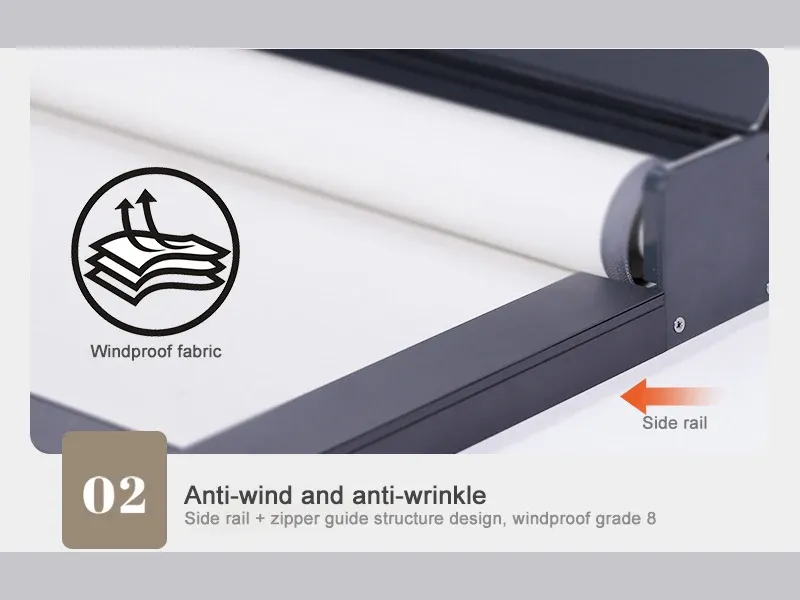
Windproof Grade 8 is a manufacturer-stated classification applied to the motorized models, with the manual models rated at Grade 10. It signifies that the system employs an integrated zipper-lock retention mechanism, reinforced aluminum extrusions, and heavy-duty composite fabric designed specifically for exposed exterior conditions.
However, international outdoor blind standards vary significantly across different manufacturing regions. Grade ratings are not standardized on a universal scale, and classifications from different factories cannot be assumed equivalent.
Crucially, a Grade 8 or Grade 10 label is not a direct substitute for a certified wind pressure test report.
Outdoor wind dynamics involve complex factors, including positive windward pressure, negative leeward suction, gust oscillations, and building corner vortices. A number on a specification sheet indicates the relative build tier of the system, but commercial buyers evaluating high-exposure coastal or high-rise projects should always request formal testing documentation or pressure test reports from their supplier rather than relying solely on a stated grade number.
The Two Engineering Factors Behind True Wind Resistance
The ability of an outdoor roller blind to withstand intense wind pressure depends on two interdependent elements: mechanical perimeter retention and fabric material physics.
1. Structural Mechanical Retention: Zipper Teeth and Aluminum Side Channels
In traditional exterior blinds, fabric floats freely or rides along loose stainless steel guide cables. Under moderate air movement, wind readily gets behind the fabric, creating suction that pulls edges outward, generates loud flapping noise, and bends bottom bars.
A genuine windproof roller blind relies on a continuous zipper-guided (zip-track) mechanical lock.
- Continuous Edge Retention: Symmetrical zipper teeth are welded directly along both vertical edges of the screen fabric.
- Enclosed Channel Track: These teeth slide inside a precision-extruded aluminum side channel equipped with high-durability internal polymer inserts.
- Distributed Load Transfer: When lateral wind impacts the blind face, the zipper teeth lock against the channel shoulders along the entire height of the drop. Instead of concentrating stress at corners or fixing screws, the pressure distributes evenly down the structural aluminum jambs.
This mechanical retention makes zipper-guided systems substantially more wind-resistant than cable-guided or gravity-drop alternatives. You can inspect the mechanical engineering and view wind test video directly on the eziptrack /features page.
2. Fabric Engineering: Weight and Dimensional Stability
Mechanical side channels can only hold a blind in place if the fabric itself does not stretch, deform, or tear under tension.
Lightweight polyester fabrics or standard interior screen materials stretch under lateral pressure. Once a fabric stretches, it pulls inward, placing excessive localized shear stress on the zipper weld seams.
High-performance exterior windproof blinds require dense composite textiles:
- Composite Formulation: A balance of 30% high-tenacity polyester core yarns coated with 70% protective polyvinyl chloride (PVC).
- Substantial Weight: A heavy specification of 565 g/m² (±5%), providing structural stiffness and eliminating fabric flutter.
- Calibrated Thickness: An overall material thickness of 0.70 mm (±5%), ensuring robust puncture and tear resistance while allowing smooth winding inside the headbox.
- Broad Roll Widths: Seamless fabrication across opening widths of 200 cm, 250 cm, 300 cm, and 320 cm.
While physical weight directly drives wind resilience, fabric openness rate remains an independent variable governing outward visibility and airflow. To learn how visual permeability balances with environmental protection, consult our /openness-rate-guide.
How to Read the Fabric Strength Figure (N/5cm Explained)
When examining commercial specification sheets for exterior blinds, structural engineers and buyers will encounter technical strength measurements expressed in N/5cm.
N/5cm stands for Newtons per 5 centimeters of fabric width. It is the unit used on textile strength test reports: a strip of fabric 5 centimeters wide is gripped and pulled until it fails, and the force at failure is recorded.
One Newton is the force needed to accelerate a one kilogram mass at one meter per second squared. A figure in the thousands of Newtons per 5 cm therefore represents a very high load for a strip of coated fabric.
Tear resistance is warp ≥2650 N/5cm and weft ≥2450 N/5cm (manufacturer-stated). Note that "tear resistance" here refers to the figure quoted by the manufacturer on the fabric data sheet; always confirm the exact test method and direction with the supplier for a specific project.
Understanding the distinction between warp and weft is vital for outdoor blind applications:
- Warp (Vertical Direction ≥2650 N/5cm): Warp threads run the full vertical length of the drop. They support the deadweight of the weighted bottom rail, withstand the torque exerted by the motorized roller tube during operation, and prevent the blind from sagging over long drops.
- Weft (Horizontal Direction ≥2450 N/5cm): Weft threads run horizontally from left to right across the span. Under lateral wind load, this axis bears the full cross-directional pull exerted between the two vertical side channels. A high weft tensile rating prevents the zipper weld seam from shearing away from the screen body.
To maintain this tensile integrity over years of harsh outdoor exposure, exterior fabrics must also possess certified environmental stability:
- Flame Retardancy Certifications: Compliance with NFPA 701-2015 TM#2, BS 5867 Part 2 Type B, and DIN 4102-1 B1 standards, ensuring safety in commercial hospitality spaces.
- Colorfastness to Light: ISO 105 B02 Grade 8 rating, a measure of how little the fabric colour shifts under prolonged light exposure.
When Must Outdoor Roller Blinds Be Retracted? (Safety Boundaries)
A primary misconception among property owners and commercial facility managers is that a "windproof" blind can be left deployed in any storm.
Outdoor roller blinds are advanced, dynamic building envelope accessories; they are not permanent concrete storm shutters. Maintaining realistic safety boundaries protects both the mechanism and the surrounding architectural structure.
Here is the operational guide on when outdoor blinds must be retracted:
- Official Severe Weather and Gale Warnings: Whenever regional meteorological authorities issue severe storm warnings, gale advisories, or extreme weather alerts, all outdoor roller blinds should be fully retracted into their protective headboxes before the front arrives.
- Visible Environmental Indicators: In the absence of an active weather forecast, observe the immediate surroundings. If mature tree trunks are swaying forcefully, large branches are bending or breaking, loose patio furniture is shifting, or walking against the wind becomes difficult, retract the blinds immediately.
- Anticipated Sudden Squalls: In coastal, desert, or mountain valley zones where sudden microbursts and violent wind shear occur, blinds should not be left extended overnight or during unattended operating hours.
- Unattended Commercial Facilities: Restaurants, resorts, and outdoor venues should make blind retraction a standard operating protocol at daily closing.
Critical Operating Rule: Retract Early, Never Force During Extreme Load
Blinds should always be rolled up before peak turbulence develops.
When severe wind pushes relentlessly against the fabric, the zipper teeth press with intense lateral force against the internal channel walls. Attempting to motorize or manually crank a blind up during extreme, active wind forces the drive system to fight severe friction, which can overheat tubular motors, shear gearboxes, or scuff zipper teeth.
If extreme squalls arrive unexpectedly while the blind is already fully down, it is often safer to leave it fully anchored in its locked position until the wind subsides rather than partially opening it. A half-open blind allows high-velocity air underneath, creating an aerodynamic parachute effect that exerts destructive upward and outward uplift on the entire assembly.
B2B Procurement Checklist for High-Wind and Coastal Projects
For overseas distributors, builders, and outdoor shading specialists sourcing blinds for wind-exposed markets, use this technical checklist to vet suppliers:
- Verify True Zipper-Guided Mechanical Locking: Confirm that the system uses continuously welded zipper teeth running inside structural aluminum tracks rather than loose stainless steel guide wires or floating hem weights.
- Audit the Fabric Strength Data: Inspect manufacturer technical sheets for specific strip tensile strength figures (such as warp ≥2650 N/5cm and weft ≥2450 N/5cm) rather than accepting vague marketing descriptions like "heavy-duty fabric."
- Size Cassette Profiles to Span Widths: Wind deflection increases exponentially as opening spans widen. Ensure the supplier offers model series sized for the opening—ZT90, ZT110, ZT150, ZT170 and ZT180 cover different span ranges—so the roller tube does not deflect over wide openings. Explore standard dimensional configurations on our /products page.
- Assess Base Substrate and Anchor Fasteners: The strongest blind will fail if anchored into loose stucco or thin sheet metal. Fasteners must secure into reinforced masonry, structural timber posts, or heavy-gauge steel framing capable of handling substantial pull-out shear.
- Request Project Technical Documentation: For large-scale developments or municipal projects requiring verified wind calculations, request full engineering datasheets, installation schematics, and factory pressure testing documentation.
Frequently Asked Questions (FAQ)
Can outdoor roller blinds withstand storms and heavy winds?
Zipper-guided outdoor roller blinds are engineered to handle vigorous everyday outdoor wind loads and moderate coastal conditions when fully deployed. However, they are dynamic architectural shading systems rather than permanent hurricane barriers, and they must be fully retracted into their headboxes during severe storm alerts or extreme weather events.
What does "windproof grade 8" (and grade 10) mean on a manufacturer specification sheet?
Windproof Grade 8 is a manufacturer-stated classification applied to the eziptrack motorized models, with the manual versions rated at Grade 10. Because rating scales differ across the window-covering industry, a grade number indicates robust construction features (such as zipper side channels and high-tensile fabric) rather than an interchangeable universal wind velocity figure.
Is a motorized zip-track blind stronger than a manual hand-crank model?
Both motorized systems and manual crank models utilize identical structural side channels, zipper edge retention, and heavy composite fabric. The static wind-holding capability remains comparable; however, motorized blinds equipped with tubular motors provide smoother, more uniform fabric tensioning during daily deployment.
What happens if an outdoor blind is left deployed during extreme gale conditions?
Leaving any outdoor blind deployed during extreme gale-force conditions risks structural damage. Extreme aerodynamic forces can bend vertical tracks, over-stress structural wall anchors, deform roller tubes, or damage the zipper weld bond. Retracting blinds ahead of severe weather protects your investment.
How does fabric openness rate affect wind resistance?
Fabric openness rate (such as 3%, 5%, or 14%) determines the tightness of the textile weave and the amount of ambient air filtering through the screen. While denser weaves block more draft, the overall mechanical wind resistance of the blind is governed primarily by the aluminum side-channel retention and the composite fabric's tensile tear strength.
Can a zip screen blind be mounted directly to an outdoor pergola?
Yes. A zip screen blind mounts directly to aluminium or timber pergola posts, with the aluminium side tracks fastened vertically to the posts and the welded zipper edges running inside them so the screen stays taut. For wide spans, motorized models cover widths up to 5 m on the ZT150 and up to 14 m on the ZT180, creating a sheltered dining or seating zone.
How do I stop an outdoor roller blind from flapping in the wind?
Replace a loose-hanging blind or a cable-guided system with a zipper-guided track blind. Welded zipper teeth run continuously inside extruded aluminium side tracks and lock both fabric edges along the full drop, so lateral wind pressure is taken up as tension across the fabric. The manufacturer states wind resistance of grade 10 on manual models and grade 8 on motorized models.
What sizes can a windproof roller blind be made in?
Available sizes depend on the model. The ZT150 motorized blind covers widths from 0.85 m to 5 m with drops up to 5 m. For large commercial openings the ZT180 spans up to 14 m wide and 7 m high on heavy-duty aluminium profiles. The manual models cover 500-4000 mm and 1200-4000 mm in width respectively.
Technical Specifications and Engineering Inquiries
Selecting the correct outdoor shading configuration for wind-prone residential and commercial installations requires precise matching of span widths, tube diameters, and architectural anchoring substrates.
Whether you are designing a high-exposure perimeter enclosure or sourcing dependable zip-track exterior blinds for overseas distribution, the eziptrack technical team provides comprehensive component specifications, dimensional profiles, and structural guidance tailored to your project requirements.
To discuss project dimensions, review engineering datasheets, or request formal quotations, contact our engineering export desk directly through our /contact-us portal or email raymond@eziptrack.com.